LeetCode in Kotlin


3924. Minimum Threshold Path With Limited Heavy Edges
Hard
There is an undirected weighted graph with n nodes labeled from 0 to n - 1.
The graph is represented by a 2D integer array edges, where each edge edges[i] = [ui, vi, wi] indicates that there is an undirected edge between nodes ui and vi with weight wi.
You are also given integers source, target and k.
A threshold value determines whether an edge is considered light or heavy:
-
An edge is light if its weight is less than or equal to
threshold. -
An edge is heavy if its weight is greater than
threshold.
A path from source to target is valid if it contains at most k heavy edges.
Return the minimum integer threshold such that at least one valid path exists from source to target. If no such path exists, return -1.
Example 1:
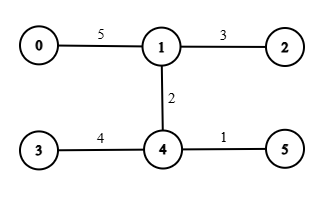
Input: n = 6, edges = [[0,1,5],[1,2,3],[3,4,4],[4,5,1],[1,4,2]], source = 0, target = 3, k = 1
Output: 4
Explanation:
The minimum threshold such that a path from node 0 to node 3 uses at most 1 heavy edge is 4.
-
Light edges:
[1, 2, 3],[3, 4, 4],[4, 5, 1],[1, 4, 2] -
Heavy edges:
[0, 1, 5]
A valid path is 0 → 1 → 4 → 3. It uses only 1 heavy edge ([0, 1, 5]), which satisfies the limit k = 1.
Any smaller threshold would make it impossible to reach node 3 without exceeding 1 heavy edge.
Example 2:
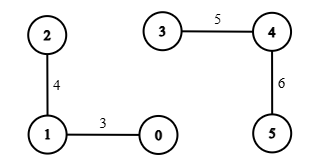
Input: n = 6, edges = [[0,1,3],[1,2,4],[3,4,5],[4,5,6]], source = 0, target = 4, k = 1
Output: -1
Explanation:
There is no path from node 0 to node 4. Since the target cannot be reached, the output is -1.
Example 3:
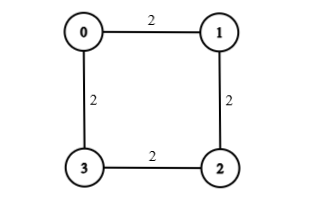
Input: n = 4, edges = [[0,1,2],[1,2,2],[2,3,2],[3,0,2]], source = 0, target = 0, k = 0
Output: 0
Explanation:
The source and target are the same node. No edges need to be traversed, so the minimum threshold is 0.
Constraints:
1 <= n <= 1030 <= edges.length <= 103edges[i] = [ui, vi, wi]0 <= ui, vi <= n - 11 <= wi <= 1090 <= source, target <= n - 10 <= k <= edges.length
Solution
class Solution {
    private lateinit var head: IntArray
    private lateinit var to: IntArray
    private lateinit var weight: IntArray
    private lateinit var next: IntArray
    private var n = 0
    private var source = 0
    private var target = 0
    private var k = 0

    fun minimumThreshold(n: Int, edges: Array<IntArray>, source: Int, target: Int, k: Int): Int {
        if (source == target) {
            return 0
        }
        this.n = n
        this.source = source
        this.target = target
        this.k = k
        // make adj list (you dont have to do this fancy version, standard adj list works)
        val m = edges.size
        this.head = IntArray(n)
        this.to = IntArray(m shl 1)
        this.weight = IntArray(m shl 1)
        this.next = IntArray(m shl 1)
        head.fill(-1)
        for (i in 0..<m) {
            val a = edges[i][0]
            val b = edges[i][1]
            val c = edges[i][2]
            to[i shl 1] = b
            next[i shl 1] = head[a]
            head[a] = i shl 1
            to[i shl 1 or 1] = a
            next[i shl 1 or 1] = head[b]
            head[b] = i shl 1 or 1
            weight[i shl 1 or 1] = c
            weight[i shl 1] = weight[i shl 1 or 1]
        }
        // check if it's possible to reach the target at all
        if (!check(Int.MAX_VALUE)) {
            return -1
        }
        if (k == m) {
            return 0
        }
        var left = 0
        var right = 0
        // set right pointer to max edge weight, cuz any threshold larger than that is pointless
        for (edge in edges) {
            if (edge[2] > right) {
                right = edge[2]
            }
        }
        // binary search on the answer
        while (left < right) {
            val mid = left + right ushr 1
            if (check(mid)) {
                right = mid
            } else {
                left = mid + 1
            }
        }
        return left
    }

    private fun check(threshold: Int): Boolean {
        // 0-1 BFS
        val dist = IntArray(n)
        dist.fill(k + 1)
        dist[source] = 0
        val queue = java.util.ArrayDeque<Int>(n)
        queue.add(source)
        while (queue.isNotEmpty()) {
            val current: Int = queue.poll()!!
            if (current == target) {
                return true
            }
            val currentDist = dist[current]
            // go through each adj node (a regular adj list works here as well)
            var i = head[current]
            while (i != -1) {
                val node = to[i]
                val newWeight = if (weight[i] > threshold) 1 else 0
                val newDist = newWeight + currentDist
                if (newDist < dist[node]) {
                    dist[node] = newDist
                    if (newWeight == 0) {
                        queue.addFirst(node)
                    } else {
                        queue.addLast(node)
                    }
                }
                i = next[i]
            }
        }
        return false
    }
}