LeetCode in Kotlin


3148. Maximum Difference Score in a Grid
Medium
You are given an m x n matrix grid consisting of positive integers. You can move from a cell in the matrix to any other cell that is either to the bottom or to the right (not necessarily adjacent). The score of a move from a cell with the value c1 to a cell with the value c2 is c2 - c1.
You can start at any cell, and you have to make at least one move.
Return the maximum total score you can achieve.
Example 1:
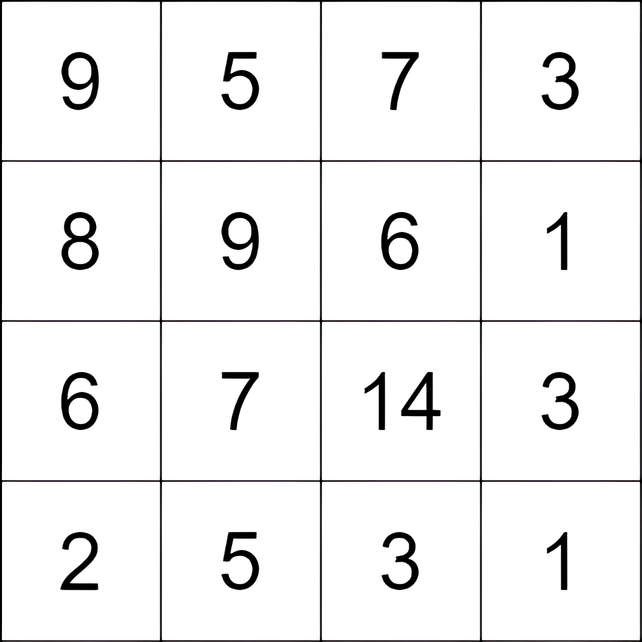
Input: grid = [[9,5,7,3],[8,9,6,1],[6,7,14,3],[2,5,3,1]]
Output: 9
Explanation: We start at the cell (0, 1), and we perform the following moves:
-
Move from the cell
(0, 1)to(2, 1)with a score of7 - 5 = 2. -
Move from the cell
(2, 1)to(2, 2)with a score of14 - 7 = 7.
The total score is 2 + 7 = 9.
Example 2:
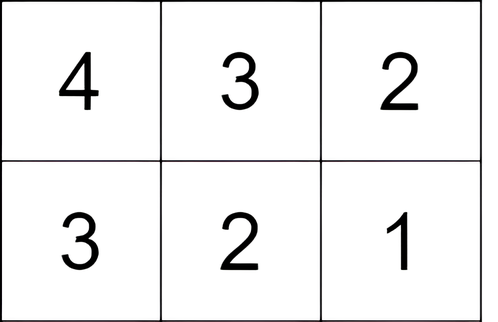
Input: grid = [[4,3,2],[3,2,1]]
Output: -1
Explanation: We start at the cell (0, 0), and we perform one move: (0, 0) to (0, 1). The score is 3 - 4 = -1.
Constraints:
m == grid.lengthn == grid[i].length2 <= m, n <= 10004 <= m * n <= 1051 <= grid[i][j] <= 105
Solution
import kotlin.math.max

class Solution {
    fun maxScore(grid: List<List<Int>>): Int {
        val m = grid.size - 1
        var row = grid[m]
        var n = row.size
        val maxRB = IntArray(n--)
        maxRB[n] = row[n]
        var mx = maxRB[n]
        var result = Int.MIN_VALUE
        for (i in n - 1 downTo 0) {
            val x = row[i]
            result = max(result, (mx - x))
            mx = max(mx, x)
            maxRB[i] = mx
        }
        for (i in m - 1 downTo 0) {
            row = grid[i]
            mx = 0
            for (j in n downTo 0) {
                mx = max(mx, maxRB[j])
                val x = row[j]
                result = max(result, (mx - x))
                mx = max(mx, x)
                maxRB[j] = mx
            }
        }
        return result
    }
}