LeetCode in Kotlin


2556. Disconnect Path in a Binary Matrix by at Most One Flip
Medium
You are given a 0-indexed m x n binary matrix grid. You can move from a cell (row, col) to any of the cells (row + 1, col) or (row, col + 1) that has the value 1. The matrix is disconnected if there is no path from (0, 0) to (m - 1, n - 1).
You can flip the value of at most one (possibly none) cell. You cannot flip the cells (0, 0) and (m - 1, n - 1).
Return true if it is possible to make the matrix disconnect or false otherwise.
Note that flipping a cell changes its value from 0 to 1 or from 1 to 0.
Example 1:
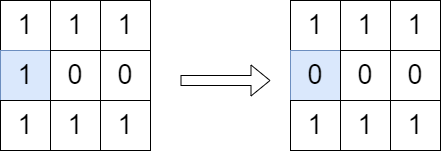
Input: grid = [[1,1,1],[1,0,0],[1,1,1]]
Output: true
Explanation:
We can change the cell shown in the diagram above. There is no path from (0, 0) to (2, 2) in the resulting grid.
Example 2:
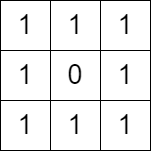
Input: grid = [[1,1,1],[1,0,1],[1,1,1]]
Output: false
Explanation:
It is not possible to change at most one cell such that there is not path from (0, 0) to (2, 2).
Constraints:
m == grid.lengthn == grid[i].length1 <= m, n <= 10001 <= m * n <= 105grid[i][j]is either0or1.grid[0][0] == grid[m - 1][n - 1] == 1
Solution
class Solution {
    fun isPossibleToCutPath(grid: Array<IntArray>): Boolean {
        val n = grid.size
        val m = grid[0].size
        dfs(0, 0, grid, n, m)
        grid[0][0] = 1
        return !dfs(0, 0, grid, n, m)
    }

    private fun dfs(i: Int, j: Int, a: Array<IntArray>, n: Int, m: Int): Boolean {
        if (i >= n || j >= m || i < 0 || j < 0 || a[i][j] == 0) return false
        if (i == n - 1 && j == m - 1) return true
        a[i][j] = 0
        return dfs(i + 1, j, a, n, m) || dfs(i, j + 1, a, n, m)
    }
}