LeetCode in Kotlin


2133. Check if Every Row and Column Contains All Numbers
Easy
An n x n matrix is valid if every row and every column contains all the integers from 1 to n (inclusive).
Given an n x n integer matrix matrix, return true if the matrix is valid. Otherwise, return false.
Example 1:
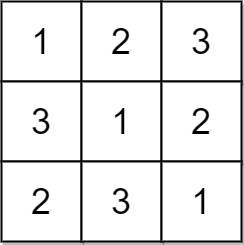
Input: matrix = [[1,2,3],[3,1,2],[2,3,1]]
Output: true
Explanation: In this case, n = 3, and every row and column contains the numbers 1, 2, and 3. Hence, we return true.
Example 2:
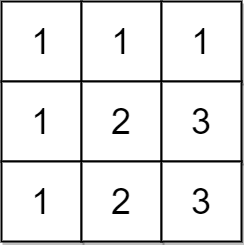
Input: matrix = [[1,1,1],[1,2,3],[1,2,3]]
Output: false
Explanation: In this case, n = 3, but the first row and the first column do not contain the numbers 2 or 3. Hence, we return false.
Constraints:
n == matrix.length == matrix[i].length1 <= n <= 1001 <= matrix[i][j] <= n
Solution
class Solution {
    fun checkValid(matrix: Array<IntArray>): Boolean {
        val n = matrix.size
        val set: MutableSet<Int> = HashSet()
        for (ints in matrix) {
            for (anInt in ints) {
                set.add(anInt)
            }
            if (set.size != n) {
                return false
            }
            set.clear()
        }
        for (i in matrix[0].indices) {
            for (ints in matrix) {
                set.add(ints[i])
            }
            if (set.size != n) {
                return false
            }
            set.clear()
        }
        return true
    }
}